What Makes a Building 'Smart'? — Five Tests Any Building Must Pass
Copied to clipboard ✓
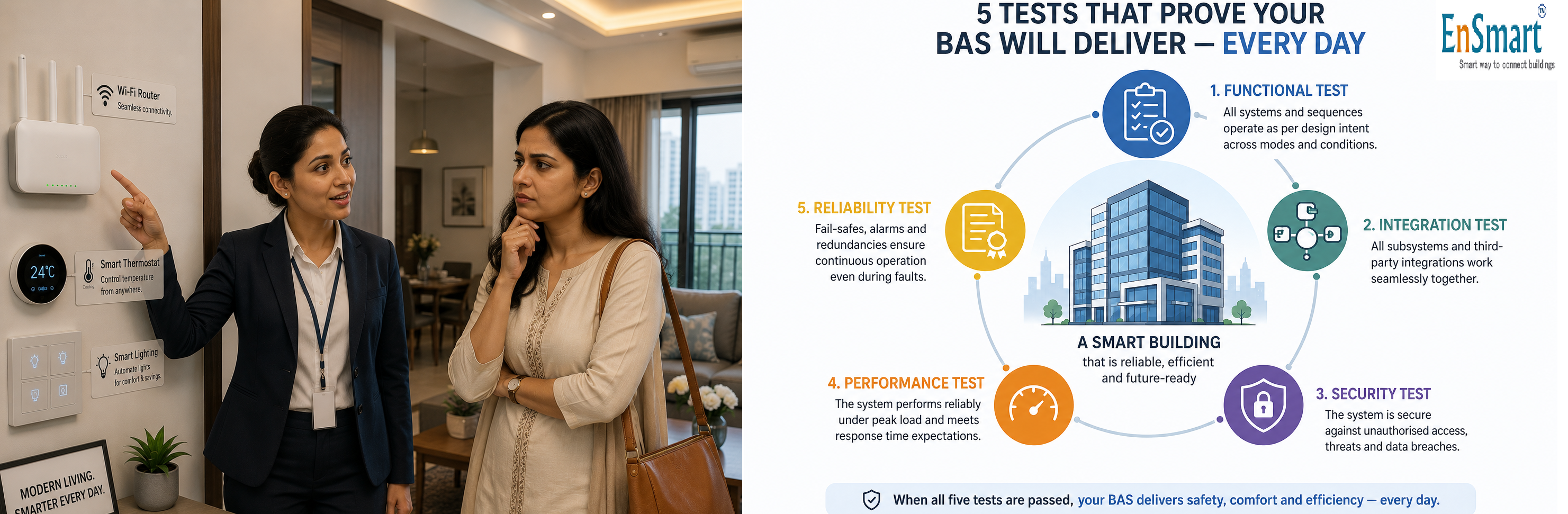
A Chennai OMR Showroom, an Honest Question
Geetha is a software engineer in Chennai. She is buying her first apartment. The brochure for the OMR project promises a smart home in a smart building. The salesperson is enthusiastic. "The whole tower is smart, ma'am. Wi-Fi everywhere. Every flat has app-controlled lights. Smart parking with QR codes." Geetha listens. Then asks: "And what does the building do when no one is in it?" The salesperson hesitates. Geetha asks the next question: "How does the building know how much energy I used last week, and why?" The salesperson does not have an answer. That is because most "smart" buildings are not smart — they are gadgeted. Smart is a different thing. Every single one of these problems has one solution — the five tests of a smart building.The Five Tests
A genuinely smart building does five things without a human asking it to. ``` Test 1 — Sensing The building knows what is happening — temperature, humidity, occupancy, energy use, equipment health, air quality, water flow. Not just at one point, but at every meaningful zone. Test 2 — Deciding The building turns sensed data into decisions. AC steps down when occupancy drops. Fresh-air damper opens when CO2 rises. Pump speed reduces when load is light. The decisions are made by logic, not by an operator clicking a button. Test 3 — Acting The building acts on its own decisions. Actuators respond. Schedules execute. Alarms escalate. The action loop closes without a human in the middle. Test 4 — Recording Every reading, every decision, every action — recorded. Time-stamped. Searchable. Two years later, the building can answer "why did the AC run at 3 AM on March 14?" Test 5 — Learning The building improves week over week. Last Monday's occupancy ramp is remembered for next Monday. Last summer's chiller load predicts this summer's. The schedules write themselves. ``` A building that passes all five is smart. A building that passes only sensing and acting is automated, not smart. A building with only Wi-Fi and an app is connected, not smart.Why Apps Are Not Smartness
``` App-controlled lights You replaced the wall switch with a phone. The building did not get smarter — you did a small UX upgrade. Wi-Fi everywhere You added a network. Smart needs a brain connected to that network, not just a wire. QR-code parking Convenience for the visitor. The building does not know how full it is unless the QR system feeds occupancy back to the BMS. Voice-controlled curtain A novelty until it stops working. The building does not get smarter from a voice layer — it gets smarter from sensing, deciding, and learning. ``` The phone, the app, the QR code, the voice — these are interfaces. They sit on top of smartness. They do not create smartness.What Smart Looks Like in Practice
``` A smart office floor on a Friday at 7 PM: Last person swipes out access count → 0 Occupancy sensor confirms PIR + mmWave AHU schedule shifts to night setpoint 28 °C, 60 percent fan Lighting dims to 5 percent for security safe-walking corridor Chilled water valve closes chiller stages down Energy recorded for the day kWh per zone, per circuit Sunday weather predicted building pre-cools Sunday ``` No one issued a single command. The building did this on its own. Smart is not a brochure word. Smart is a five-question test the building either passes or fails. Buildings that pass become quieter, cheaper to run, and easier to live in. Buildings that fail keep needing humans to do what machines can do.Related Topics
- What is BMS integration? — how a BMS connects with VFDs, energy meters, BACnet/Modbus devices and other building systems
- How to design a BMS system step by step — the complete BMS design methodology covering site survey, IO list, controller selection, sequence of operations
- What is a Building Management System (BMS)? — fundamentals of BMS controls and architecture for HVAC, lighting, energy and access
- What is BMS commissioning? — the disciplined commissioning process that turns a BMS install into a working building brain
- Browse all General BMS topics topics — more from this section of the EnSmart BMS Library
Related Topics
- What is BMS integration? — how a BMS connects with VFDs, energy meters, BACnet/Modbus devices and other building systems
- How to design a BMS system step by step — the complete BMS design methodology covering site survey, IO list, controller selection, sequence of operations
- What is a Building Management System (BMS)? — fundamentals of BMS controls and architecture for HVAC, lighting, energy and access
- What is BMS commissioning? — the disciplined commissioning process that turns a BMS install into a working building brain
- Browse all General BMS topics topics — more from this section of the EnSmart BMS Library
Related Topics
- What is BMS integration? — how a BMS connects with VFDs, energy meters, BACnet/Modbus devices and other building systems
- How to design a BMS system step by step — the complete BMS design methodology covering site survey, IO list, controller selection, sequence of operations
- What is a Building Management System (BMS)? — fundamentals of BMS controls and architecture for HVAC, lighting, energy and access
- What is BMS commissioning? — the disciplined commissioning process that turns a BMS install into a working building brain
- Browse all General BMS topics topics — more from this section of the EnSmart BMS Library
Related Topics
- What is BMS integration? — how a BMS connects with VFDs, energy meters, BACnet/Modbus devices and other building systems
- How to design a BMS system step by step — the complete BMS design methodology covering site survey, IO list, controller selection, sequence of operations
- What is a Building Management System (BMS)? — fundamentals of BMS controls and architecture for HVAC, lighting, energy and access
- What is BMS commissioning? — the disciplined commissioning process that turns a BMS install into a working building brain
- Browse all General BMS topics topics — more from this section of the EnSmart BMS Library
Was this answer helpful?
✓ Thanks — your feedback was recorded.