Hydrogen Sensor in BMS
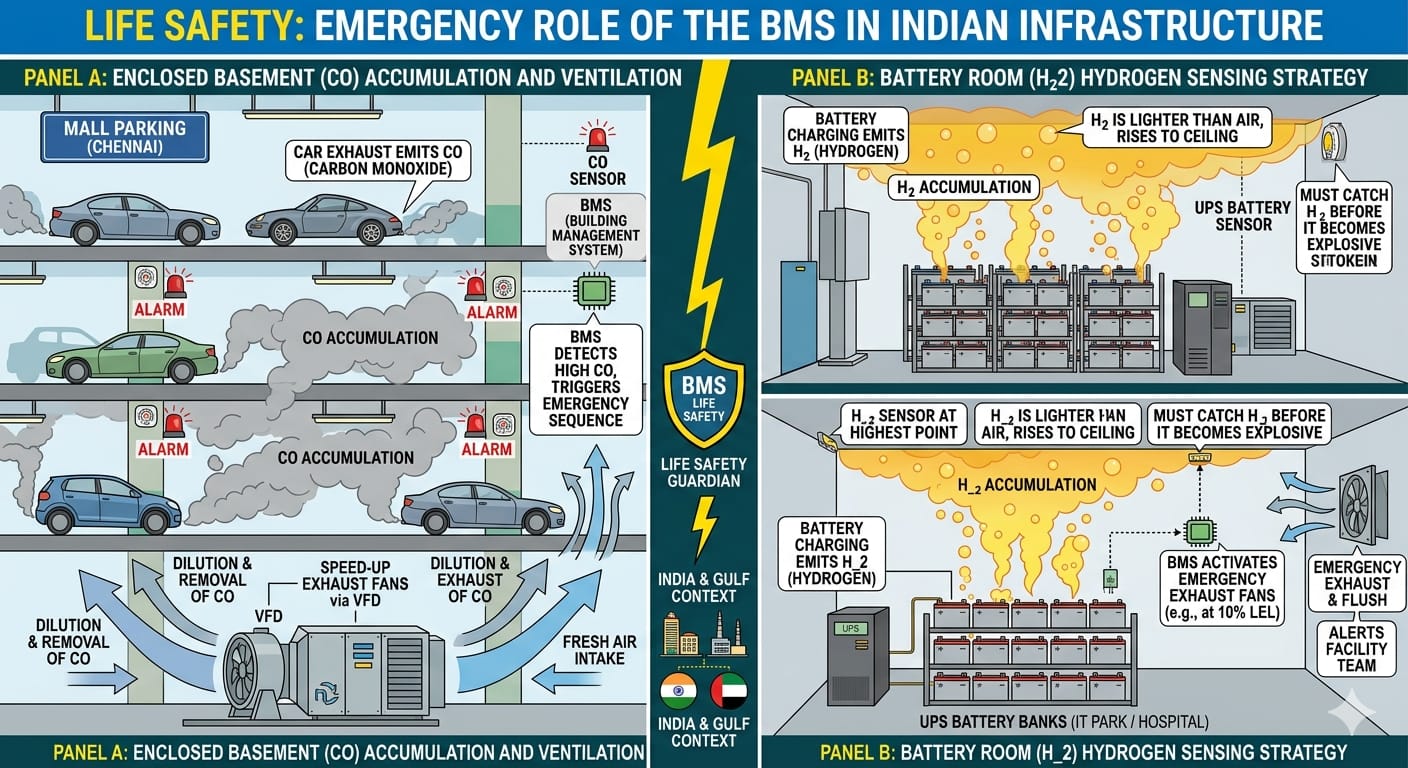
The Founder's Explanation
"In battery room — batteries emit hydrogen. Hydrogen is explosive in nature. We exhaust and mix in atmosphere air to neutralise. So we add hydrogen sensor to measure it."
Human Analogy
Your mobile phone battery, your car battery, your UPS battery — all produce tiny amounts of gas when charging. In a small room with one battery — negligible. In a battery room with hundreds of large UPS or inverter batteries all charging simultaneously — the accumulated gas is significant and dangerous.
The gas is hydrogen — H2. The lightest element. Rises immediately. Explosive.
Hydrogen ignites at very low concentrations — just 4% in air is sufficient. At higher concentrations — explosion risk is severe. A spark from any source — a light switch, a tool, static electricity — can trigger ignition.
Why Battery Rooms Need Special Treatment:
Large buildings and data centres have enormous UPS battery banks. Telecom towers have battery backup systems. All these batteries — especially lead-acid batteries — emit hydrogen during the charging cycle.
BMS Hydrogen Control:
Hydrogen sensor installed at ceiling level
(hydrogen rises — always monitor at the highest point)
        ↓
H2 below 10% LEL (Lower Explosive Limit): Monitor only
H2 reaches 10% LEL: BMS activates exhaust fan
H2 reaches 20% LEL: Maximum exhaust, critical alarm
H2 reaches 25% LEL: Emergency alarm, isolate charging if possible
        ↓
Exhaust fan removes hydrogen from battery room
Mixes with atmosphere air — concentration drops below dangerous level
        ↓
Battery room maintained safe for personnel
LEL = Lower Explosive Limit. For hydrogen: 4% by volume in air. BMS acts well before reaching this — typically at 10–25% of LEL as early warning.
Common Mistakes:
- Placing hydrogen sensor at floor level — hydrogen rises, sensor misses it
- Using CO sensor thinking it detects hydrogen — different sensor, different measurement
- No exhaust in battery room — dangerous accumulation goes undetected
Memory Hook:
Battery charges → releases hydrogen → hydrogen rises → ceiling sensor detects
→ BMS starts exhaust → mixes with atmosphere → safe
Hydrogen sensor at ceiling always — it rises.
Related Topics
- What is BMS integration? — how a BMS connects with VFDs, energy meters, BACnet/Modbus devices and other building systems
- How to design a BMS system step by step — the complete BMS design methodology covering site survey, IO list, controller selection, sequence of operations
- What is a Building Management System (BMS)? — fundamentals of BMS controls and architecture for HVAC, lighting, energy and access
- What is BMS commissioning? — the disciplined commissioning process that turns a BMS install into a working building brain
- Browse all Sensors topics — more from this section of the EnSmart BMS Library