CO Sensor (Carbon Monoxide) in BMS
The Founder's Explanation
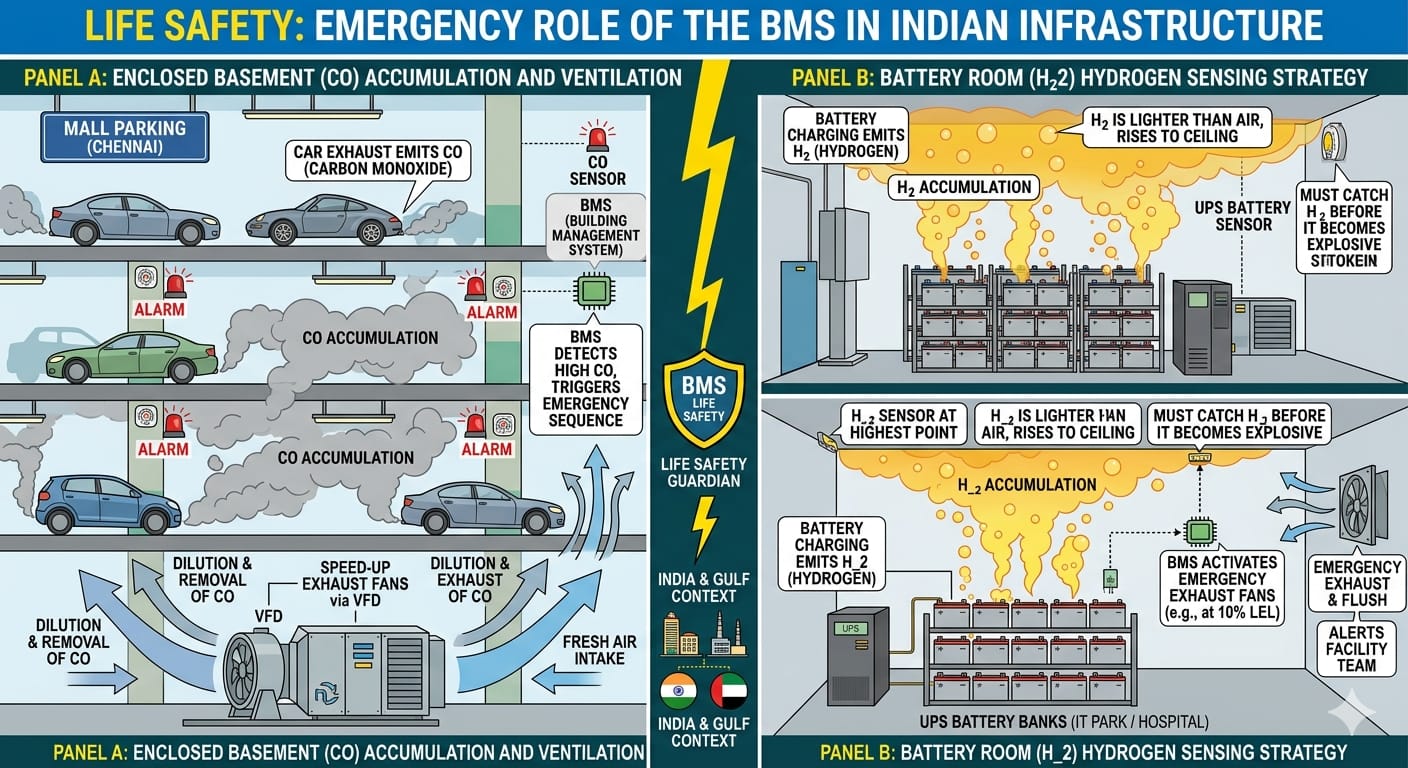
"CO sensor — used in basement parking and kitchen exhaust. Carbon monoxide from car parking is harmful to humans. We need to remove that."
Human Analogy
CO (Carbon Monoxide) is produced when any fuel burns without enough oxygen — car engines, gas heaters, faulty boilers. Unlike smoke — you cannot see it, smell it, or taste it. It enters your bloodstream and replaces oxygen silently. Symptoms start with headache. Progress to dizziness. Then unconsciousness. In high concentration — fatal.
The CO sensor is the only warning system available because human senses cannot detect CO.
In Buildings — Where CO Comes From:
Basement car parks:    Car engine exhaust — primary source
Loading docks:         Forklift and vehicle exhaust
Kitchen (gas cooking): Incomplete combustion from gas burners
Generator rooms:       Diesel generator exhaust
Boiler rooms:          Faulty or incomplete combustion
BMS CO Control — Basement Application:
CO sensor at car park level (not ceiling — CO same density as air)
        ↓
CO below 25 ppm:    Fans at minimum — energy saving
CO reaches 50 ppm:  BMS increases exhaust fan speed via VFD
CO reaches 100 ppm: BMS at maximum fan speed — alert to facility team
CO reaches 150 ppm: Emergency alarm — entry restriction considered
CO drops to safe:   BMS reduces fan speed — energy saved again
CO vs CO2 — Important Distinction:
CO  (Carbon Monoxide)  — toxic, produced by fuel combustion
                         measured in ppm
                         dangerous from 50 ppm upward
                         ODOURLESS AND INVISIBLE — only sensor detects it
CO2 (Carbon Dioxide)   — not immediately toxic at indoor concentrations
                         produced by human respiration
                         causes drowsiness and poor air quality at 1000+ ppm
                         requires much higher concentrations to be dangerous
Memory Hook:
CO = one oxygen atom = incomplete burn = deadly
CO2 = two oxygen atoms = complete burn = just stuffy
CO sensor = life safety
CO2 sensor = comfort and ventilation efficiency
Related Topics
- What is BMS integration? — how a BMS connects with VFDs, energy meters, BACnet/Modbus devices and other building systems
- How to design a BMS system step by step — the complete BMS design methodology covering site survey, IO list, controller selection, sequence of operations
- What is a Building Management System (BMS)? — fundamentals of BMS controls and architecture for HVAC, lighting, energy and access
- What is BMS commissioning? — the disciplined commissioning process that turns a BMS install into a working building brain
- Browse all Sensors topics — more from this section of the EnSmart BMS Library