Why Most BMS Front-Ends Cannot Talk to Each Other — A Short History of Closed Protocols
Copied to clipboard ✓
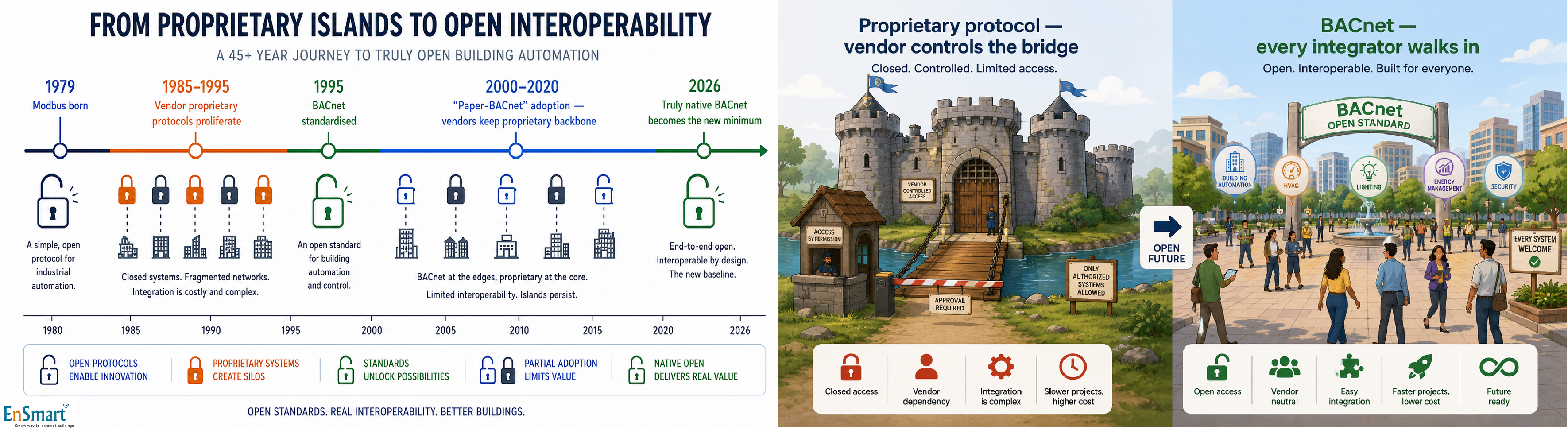
How the BMS Industry Got Here — A Forty-Year Story
In 1979, an industrial automation company published a serial communication protocol called Modbus. It was simple, plain-text, master-slave. Anyone could implement it without paying a license fee. Anyone could read the documentation in an afternoon. The intent was openness. For the next decade, the building automation industry took a different path. Through the 1980s and into the 1990s, every major BMS brand created its own protocol. Each protocol was a moat — a wall around the brand's installed base. Once a building was committed to one protocol, every spare part, every software upgrade, every new floor, every new feature had to come from the same vendor. Service margins were extraordinary. Installed base was uncatchable. This was not a conspiracy. It was a business model. And it worked. Then the consultants and large facility owners pushed back.1995 — BACnet Arrives
The American Society of Heating, Refrigerating and Air-Conditioning Engineers — ASHRAE — published the BACnet standard in 1995, formally known as ASHRAE 135 (later also ISO 16484-5). The intent was simple: Any building automation device should be able to talk to any other device, regardless of brand. For the first time, a consultant could write into a tender: "All controllers shall comply with ASHRAE 135." And in theory, every brand would now be open. In practice, the industry adapted. ``` The vendor playbook from 1995 to 2020: ─────────────────────────────────────────- Add BACnet support on every datasheet.
- Pass the BTL conformance test for marketing legitimacy.
- Keep the proprietary backbone alive for full functionality.
- Limit BACnet to a partial side door — discovery yes, but
- Charge a separate license for the BACnet feature.
- Tell the customer "use our front-end for the best experience."
Why It Mattered — And Why It Matters More Now
For a facility manager running a 2014-vintage BMS today, the cost of a closed protocol shows up every month: ``` The vendor's spare board higher price The vendor's per-floor license higher price The vendor's front-end upgrade separate quote The vendor's preferred integrator waiting list The customer's ability to switch vendors effectively zero ``` For a buyer specifying a new BMS in 2026, the cost is forward-looking: ``` Will I be locked into one vendor for twenty years? Will spare parts be available in twenty years? Will the integrator I trust today still be in business? If the vendor stops investing, will the building be stranded? ```The 2026 Standard — Truly Native BACnet
The buyer's protection is not the BACnet stamp on the datasheet. It is the architecture underneath. In 2026, the new minimum is: ```- Every variable is a discoverable BACnet object.
- No proprietary backbone underneath the BACnet layer.
- Any compliant front-end can replace the existing one.
- Any integrator can take over without re-licensing.
- The PICS document is published, not under NDA.
- The three field tests (discovery, COV, peer-to-peer) all pass.
Related Topics
- What is BMS integration? — how a BMS connects with VFDs, energy meters, BACnet/Modbus devices and other building systems
- How to design a BMS system step by step — the complete BMS design methodology covering site survey, IO list, controller selection, sequence of operations
- What is a Building Management System (BMS)? — fundamentals of BMS controls and architecture for HVAC, lighting, energy and access
- What is BMS commissioning? — the disciplined commissioning process that turns a BMS install into a working building brain
- Browse all Protocols topics — more from this section of the EnSmart BMS Library
Related Topics
- What is BMS integration? — how a BMS connects with VFDs, energy meters, BACnet/Modbus devices and other building systems
- How to design a BMS system step by step — the complete BMS design methodology covering site survey, IO list, controller selection, sequence of operations
- What is a Building Management System (BMS)? — fundamentals of BMS controls and architecture for HVAC, lighting, energy and access
- What is BMS commissioning? — the disciplined commissioning process that turns a BMS install into a working building brain
- Browse all Protocols topics — more from this section of the EnSmart BMS Library
Related Topics
- What is BMS integration? — how a BMS connects with VFDs, energy meters, BACnet/Modbus devices and other building systems
- How to design a BMS system step by step — the complete BMS design methodology covering site survey, IO list, controller selection, sequence of operations
- What is a Building Management System (BMS)? — fundamentals of BMS controls and architecture for HVAC, lighting, energy and access
- What is BMS commissioning? — the disciplined commissioning process that turns a BMS install into a working building brain
- Browse all Protocols topics — more from this section of the EnSmart BMS Library
Related Topics
- What is BMS integration? — how a BMS connects with VFDs, energy meters, BACnet/Modbus devices and other building systems
- How to design a BMS system step by step — the complete BMS design methodology covering site survey, IO list, controller selection, sequence of operations
- What is a Building Management System (BMS)? — fundamentals of BMS controls and architecture for HVAC, lighting, energy and access
- What is BMS commissioning? — the disciplined commissioning process that turns a BMS install into a working building brain
- Browse all Protocols topics — more from this section of the EnSmart BMS Library
Was this answer helpful?
✓ Thanks — your feedback was recorded.